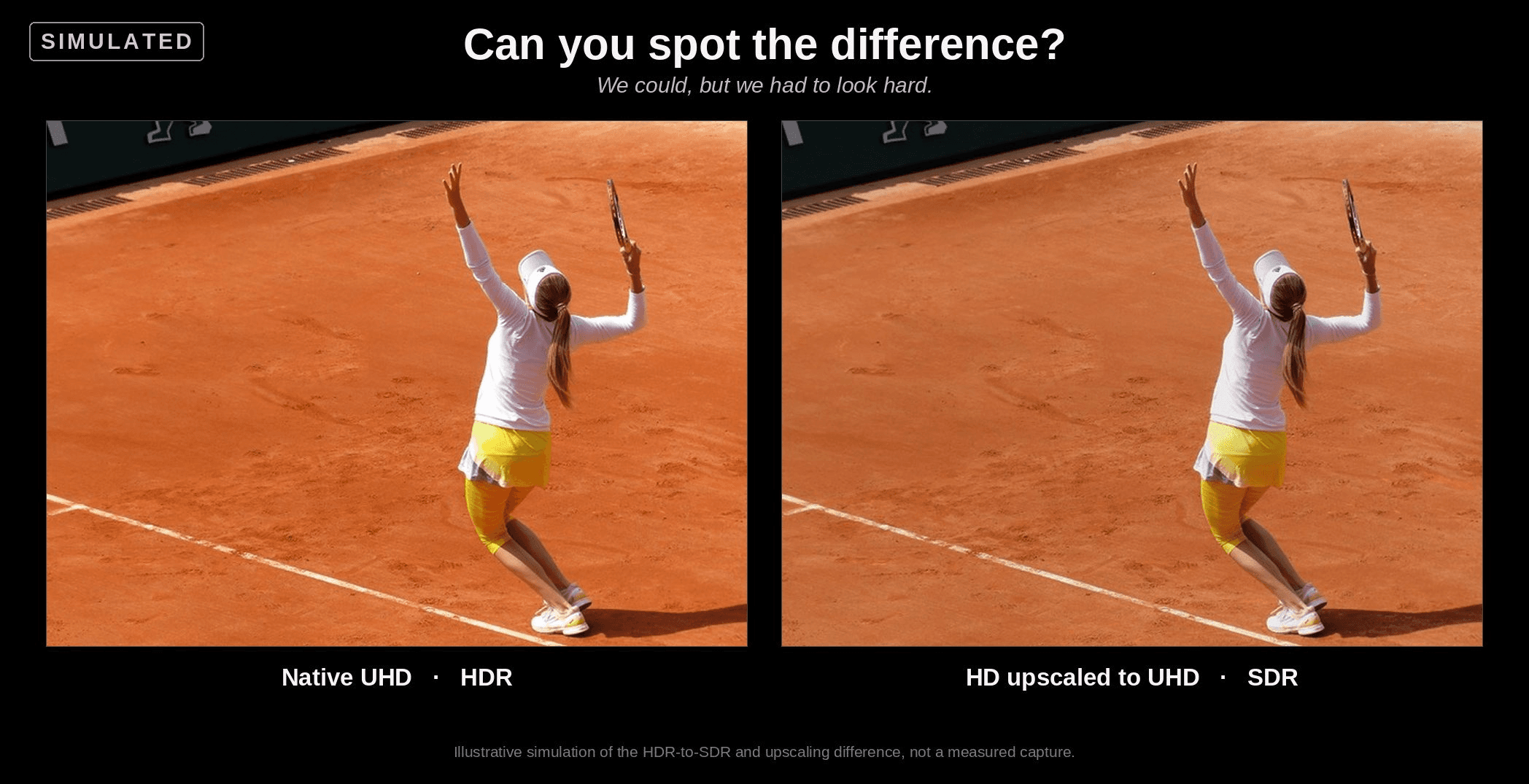
Can you spot the difference

Executive summary
Facing significant budget pressure, France Télévisions ran its France 2 UHD channel during Roland-Garros 2026 not from a native UHD production but from upscaling an HD source. The UHD infrastructure built for the Paris 2024 Olympics was reused. In our own viewing tests across multiple IPTV services, the upscaled UHD channel was very hard to distinguish from the standard HD channel. Some colours shifted slightly, but the resolution barely improved. This story is less about one broadcaster cutting corners than an early, visible example of a much wider shift, broadcasters being asked to deliver premium formats on non-premium budgets. It raises the question this article sets out to examine: when native UHD is no longer affordable, how close can enhancement technology bring an HD source to a genuine UHD experience?
The move toward UHD television has never been purely a technology story. It has always been an economics one, and Roland-Garros 2026 is an unusually clear example of how broadcasters now balance picture quality, operational complexity, infrastructure investment, and financial reality.
France Télévisions chose to run its France 2 UHD channel during the tournament using an HD-originated workflow rather than the HDR contribution feeds available to other rights holders. At first glance, that looks surprising: why feed a UHD channel from HD when better sources exist? The answer sits at the intersection of infrastructure reuse, technical architecture, and budget.
The Paris Olympics legacy
To understand the Roland-Garros decision, it helps to go back to Paris 2024. For the Olympics, France Télévisions built a UHD production and distribution chain capable of handling native 2160p HDR contribution format, while remaining compatible with legacy HD workflows. The goal was to deliver UHD across both broadcast and pay TV networks (IPTV, DTH and OTT) while staying compatible with the televisions and set-top boxes already in people’s homes.
One capability introduced for Paris 2024 matters more than the rest here: conversion flexibility. For the France 3 UHD channel, HD-originated workflows could be converted into a UHD HDR distribution service without requiring native UHD production end-to-end.
Figure 1 describes the France TV Paris Olympics workflow.
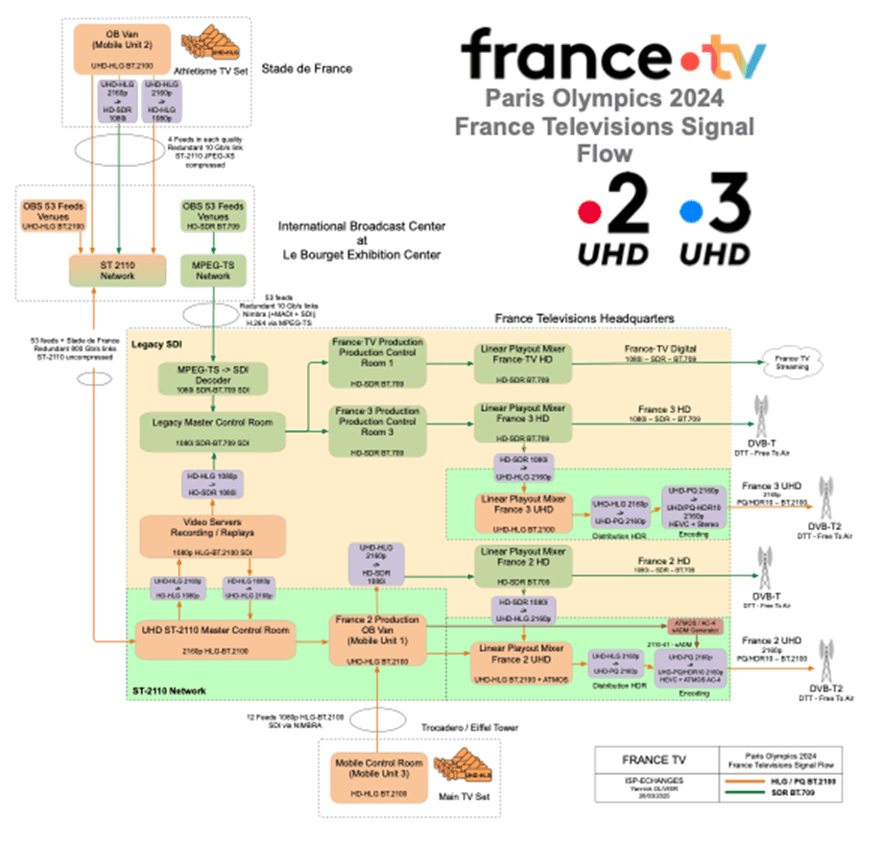
Figure 1: France Télévisions UHD deployment during Paris Olympics 2024
That flexibility proved useful for Roland-Garros 2026. Under budget pressure, France Télévisions chose not to stand up native UHD production for the tournament, even though it had done so for the Olympics, and instead reused the HD-to-UHD chain already deployed and proven in 2024. The Olympic investment, in other words, keeps paying off well after the closing ceremony.
This cost containment is, in effect, a live test of whether audiences will accept the result, which would let France TV expand its UHD offering without expanding its UHD infrastructure. It must also be read against the wider debate over French DTT modernisation, in which France TV is currently one of the only broadcasters using terrestrial transmission to carry UHD.
The Roland-Garros 2026 production environment
Before looking at what France Télévisions did with the signal, it helps to understand where that signal comes from. The host production is operated by Whisper, primarily in 1080p HDR, with selected premium matches, including the semi-finals and finals, also produced in native 2160p HDR. From there, the host infrastructure generates the downstream contribution feeds that each broadcaster adapts to its own requirements.
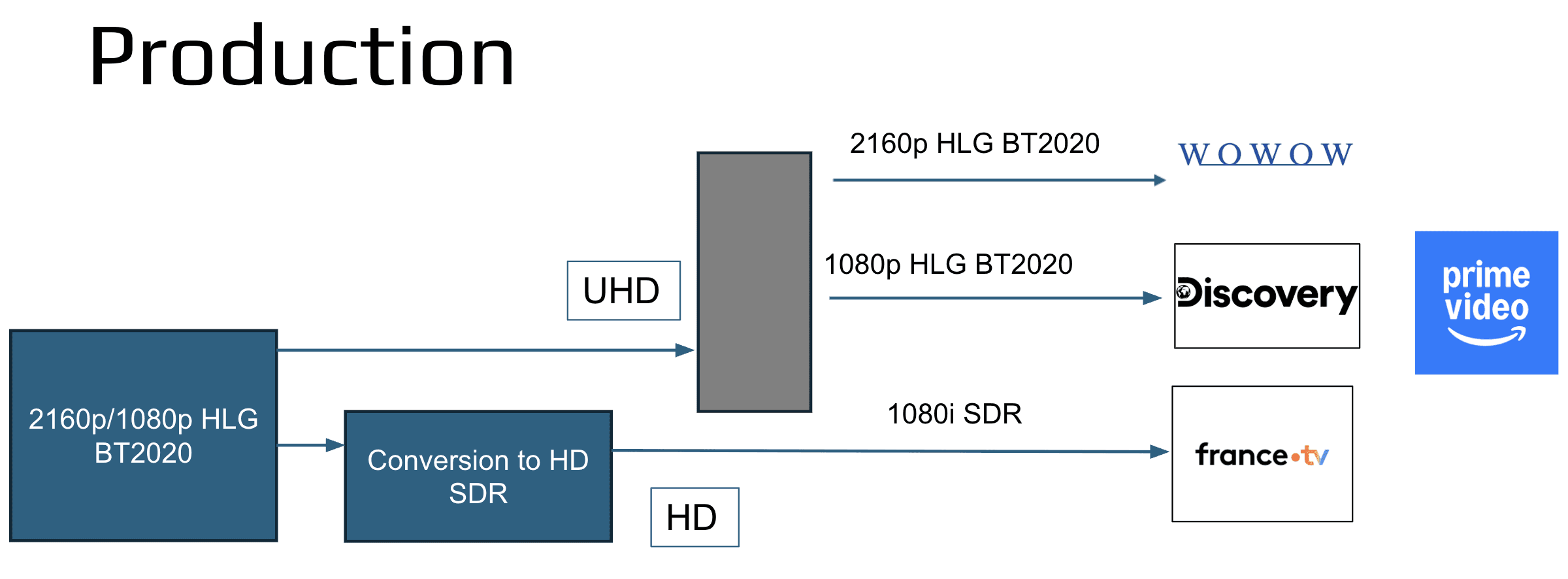
Figure 2: Roland-Garros 2026 production workflow
Different broadcasters then make different choices, depending on their priorities:
Provider | Production source | Distribution |
Warner Bros. Discovery | 1080p HDR | 1080p HDR* |
Amazon Prime Video | 1080p HDR | 1080p HDR |
France Télévisions | HD SDR-origin | 2160p HDR** |
WOWOW (Japan) | 2160p HDR | 2160p HDR |
* Warner Bros. Discovery also distributes a native UHD HDR feed in some markets, for example via Eurosport 4K on HD+ in Germany.
** The France 2 UHD channel delivers a 2160p HDR signal, but in our viewing tests the perceived gain over the HD channel was limited (see below). Production-format details here reflect public reporting and industry discussions.
The result is that Roland-Garros has become a live, side-by-side comparison of competing premium-video strategies. Some broadcasters prioritise HDR continuity, some maximise infrastructure reuse, and some preserve a full native UHD chain.
France Télévisions’ technical workflow
France Télévisions reuses the conversion chain it first deployed for Paris 2024. In outline, an HD SDR-originated signal feeds the existing HD production infrastructure; an HD SDR to UHD HLG conversion then lets it ride the UHD switching and routing built for the Olympics; and a final HLG to PQ10 conversion addresses the installed base of UHD decoders. The distributed service is 2160p PQ10 UHD.
(Public reporting has described the contribution path differently, with some accounts citing a 1080p/50 HDR capture. Our analysis focuses on the HD-originated nature of the workflow feeding the France 2 UHD distribution chain, which is the point that matters here regardless of the exact capture format.)
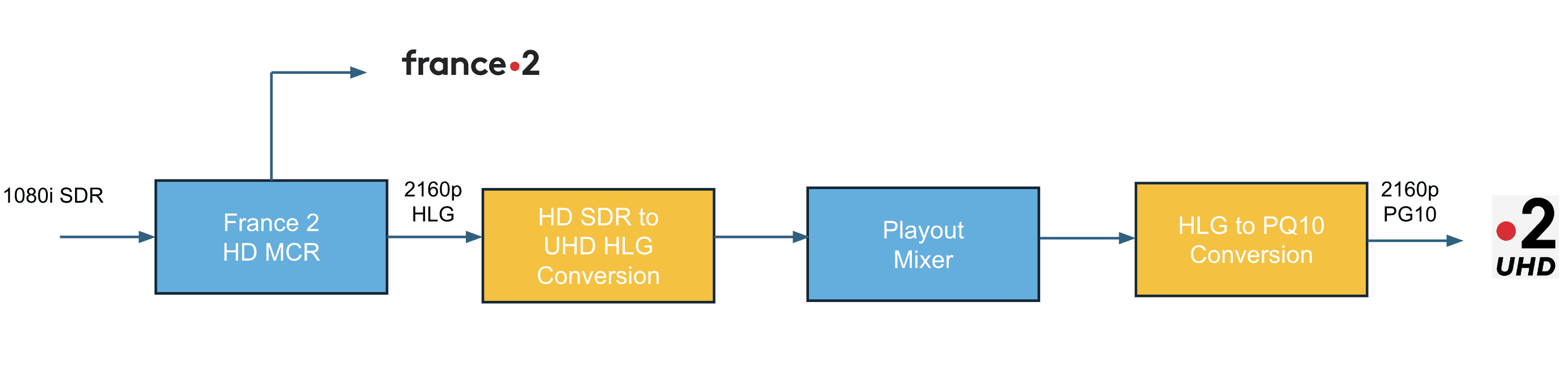
Figure 3: France 2 UHD deployment for Roland-Garros 2026
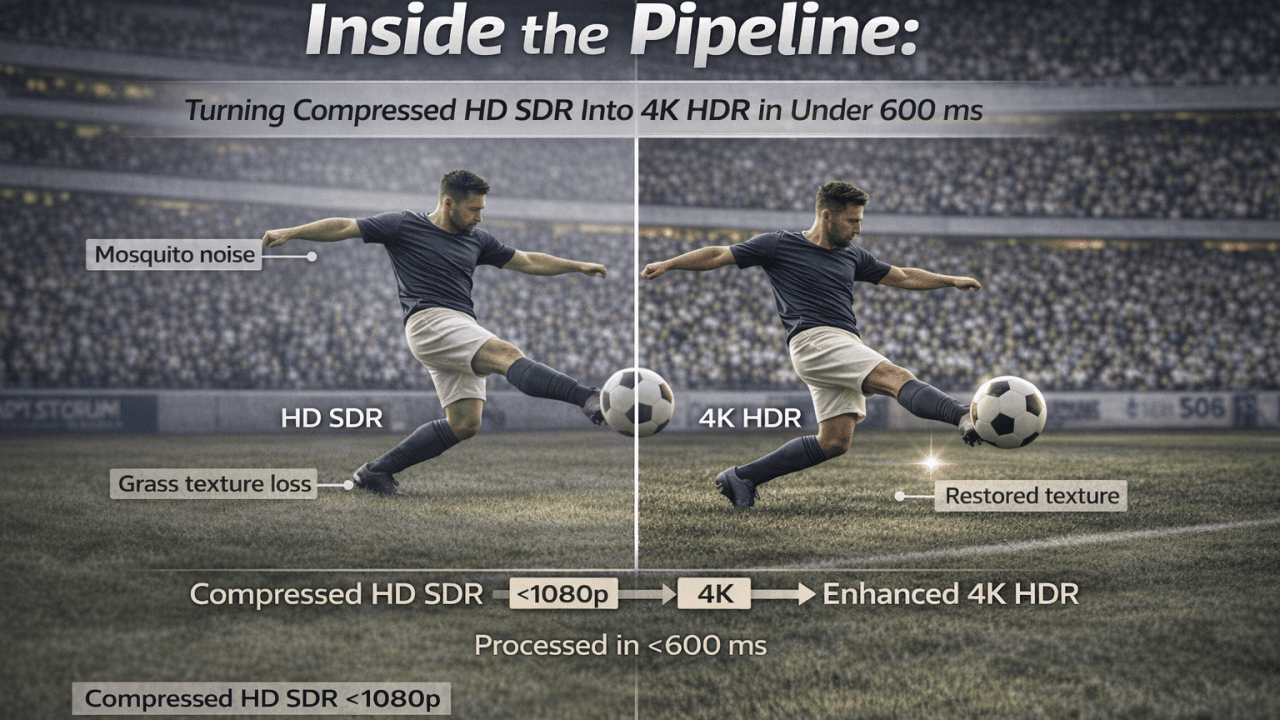
The conversion runs in two stages. First, spatial resolution: the HD signal is enhanced toward UHD using more than simple pixel interpolation, drawing on motion-adaptive reconstruction, detail recovery, edge enhancement, artefact reduction, and increasingly AI-assisted super-resolution. Second, HDR distribution compatibility: the UHD HLG signal is converted to a PQ10 profile compatible with deployed UHD televisions, connected-TV applications, and operator set-top boxes.
Native HDR versus HD-originated UHD
Roland-Garros lets viewers compare several philosophies at once, and there is no longer a single premium strategy. The trade-offs fall into three broad camps.
Native 1080p HDR preserves HDR fidelity and production intent with minimal conversion, but caps distribution resolution at HD and leaves UHD scaling to the consumer’s television, where quality varies by device.
HD-originated UHD keeps a UHD service on air with maximum infrastructure reuse and the lowest operational cost, but starts from a constrained, SDR-originated source and stacks several conversion stages whose quality depends heavily on the SDR-to-HDR processing.
Native 2160p HDR preserves the most spatial detail and HDR fidelity end-to-end with minimal artefacts, at the highest infrastructure and operating costs.
Native UHD HDR remains the reference standard. But operational constraints increasingly push broadcasters toward hybrid approaches, which is precisely what France Télévisions is doing.
Did viewers notice?
It depends. The visible gap between native UHD HDR and HD-originated UHD varies with screen size, viewing distance, bitrate, motion complexity, enhancement quality, and the scene itself. Tennis is an especially demanding test: fast camera pans, player movement, court texture, crowd detail, ball tracking, and line sharpness all expose scaling and conversion limits more aggressively than studio content.
France Télévisions’ chain is one of the more demanding live scenarios in broadcast: an HD SDR source passes through de-interlacing, SDR-to-HDR tone expansion, and HD-to-UHD enhancement before UHD HDR distribution, and every stage is an opportunity for quality to slip. De-interlacing is hard under fast sports motion, and SDR-to-HDR conversion becomes critical the moment a legacy workflow is pushed toward premium HDR output.
Traditional conversion has long relied on spatial interpolation, edge enhancement, motion-adaptive scaling, and other rule-based processing, all of which are efficient, widely deployed, and cost-effective in hardware or on-premises software. More recently, AI-native architectures have begun to incorporate learned reconstruction to preserve fine texture, reduce artefacts, and improve perceptual quality. For the most demanding pipelines, HD SDR to UHD HDR live sports among them, ML-native enhancement is the most credible candidate for narrowing the gap with native UHD HDR. Whether it can do so in practice is an open, empirical question, and the right one to test next.
What we actually saw
We watched Roland-Garros live on the France 2 HD and France 2 UHD channels across several high-end UHD televisions, using multiple IPTV services (Bouygues and SFR; Orange did not carry France 2 UHD), comparing the HD signal upscaled by the set-top box against the France 2 UHD feed, where the conversion occurs at France TV’s head end.
The result was consistent across services and displays with very little perceptible difference between the HD and UHD transmissions. In its current deployment, the HD-to-UHD upconversion does not provide sufficient quality improvement to distinguish the UHD channel from the HD channel clearly. The finding echoes what we saw during the Paris Olympics, where France 3 UHD already used this same upscaling workflow and was hard to distinguish from France 3 HD, while France 2 UHD, then running a native UHD chain, showed a clear advantage in resolution and HDR over France 2 HD. Note that our feedback came from viewing on high-end UHD TVs (with as many image processing features as possible switched off); for a more complete view (and for next time), we need to compare these images on entry-level TVs.
The conclusion we draw is deliberately narrow: today’s deployed upconversion and tone-mapping does not close the perceptual gap with native UHD HDR. Whether more advanced approaches can is an open question, and the next step is to test more capable AI-based conversion, which requires more processing power but holds out the prospect of coming closer to a native UHD experience.
The 4K television in the living room
There is a second economic equation here, and it sits in the viewer’s living room rather than the broadcaster’s machine room. For more than a decade the industry has told consumers that 4K UHD HDR is the future of premium video. Manufacturers built that promise into their product lines, retailers into their price tiers, streaming services into their top subscription levels. People who acted on it, buying 4K HDR televisions in good faith, now reasonably expect content that uses the screens they paid for.
When a flagship national broadcast of a Grand Slam arrives on the UHD channel looking essentially the same as the HD channel, the gap between expectation and delivery widens, and that is not only a technical matter. It carries reputational weight for the whole UHD value proposition that broadcasters, operators, and platforms have spent years building. The economic case for HD-originated UHD is real on the production side; the cost shows up on the consumption side, in how premium is perceived. Closing that gap, holding the perceived UHD experience even when the source is HD, is increasingly what enhancement technology is being asked to do.
Beyond Roland-Garros: When HD is the only source
Roland-Garros is a notable case precisely because France Télévisions had a higher-quality option and chose not to use it. Many broadcasters never have that choice.
In large parts of the industry, the source simply originates in HD, with no HDR contribution feed and no native UHD. That is the everyday reality across:
Regional sports
News contribution workflows
Smaller live productions
Legacy production environments
Archive libraries being monetised for modern distribution
In those settings, HD-to-UHD enhancement is not an optimisation; it is the only way to put a credible UHD service on air. Modern enhancement systems increasingly go well beyond traditional scaling: the objective is no longer to generate more pixels but to maximise perceptual quality while keeping operations efficient. For broadcasters with no premium contribution format at all, real-time ML enhancement is increasingly becoming foundational, combining enhancement, restoration, de-interlacing, tone expansion, and live HD-to-UHD processing into a single path toward better images at controlled cost.
The bigger industry reality
Native UHD remains expensive. Increasingly, broadcasters optimise around a different metric: the best perceptual quality per euro invested, achieved through HDR workflows, hybrid infrastructures, enhancement pipelines, and infrastructure reuse. These are no longer engineering compromises; they are operational strategy.
France Télévisions shows that a premium viewing experience can continue to evolve even under financial constraints. The future of premium sports distribution may not belong exclusively to native UHD. It may belong to architectures that maximise perceived quality while minimising infrastructure cost, and real-time ML enhancement increasingly sits at the centre of that equation. Roland-Garros 2026 is exactly the kind of workflow against which such enhancement should be judged. What we are witnessing is an evolving story, so stay tuned.